Healing and Wholeness: God’s Shalom – Week Four
Jesus came proclaiming the Kingdom.
His disciples asked when the Kingdom would be restored to Israel.
The decisive act was the resurrection.
Because Jesus is risen, we are freed from the guilt and power of sin. We are no longer are subject to sin’s mastery, and we are no longer subject to the power of death.
Therefore we live lives here on earth under the control, the lordship, of Christ, making his love apparent and real.
We live in a ‘now, but not yet’ time.
Our epistle is sandwiched between two more famous passages: there is no condemnation to those who are in Christ Jesus, and nothing can separate us from the love of God in Christ Jesus.
For those who do not acknowledge Jesus’ Lordship, the world seems as bad as ever. Even for those of faith, we reflect in the words of our hymns this morning the struggles of the world that we share and inhabit, and our longing to see God’s Kingdom open, revealed, triumphant. All creation ‘stands on tiptoe’ to see what will happen when God’s new kingdom is actualised. The message to the people of Bree: there is a King once more and things will get better.
In the meantime, we get glimpses, down payments on the glories of heaven that are to come.
In the midst of griefs and struggles, God sometimes heals or intervenes. Because God is God, and we do not understand all his ways, we cannot predict, command, or explain when he does this, but we humbly accept it. Because Jesus told us to teach all he commanded his disciples, we are bound to preach repentance, forgiveness, and the power of God to cleanse, heal, transform lives, in the world today.
How are we to pray? We rely upon his Spirit to guide us and pray ‘within us’: sometimes we cannot find the words.
Discussion starters:
1. What is the most hopeful thing for us about being a member of God’s kingdom?
2. What is our response to suffering and illness?
3. What could we do, as individuals and as a church family, to reach out to bless others and share God’s love and power?
Tuesday, 1 July 2008

Thursday, 12 June 2008
Sunday 8 June 2008 Healing and Wholeness Luke 15:11-32 Melanie
We pray that God would meet us where we are and move us on to where he would have us be
Amen
Melanie refers to http://www.rembrandtpainting.net/rmbrndt_1655-1669/1655-69_images/prodigal_son.jpg
Rembrandt was close to his death when he painted his picture of the Prodigal Son. It was probably one of his last works. It might not be too far fetched to see something of Rembrandt in the old father. A half blind old man, with a moustache and beard laying his large stiff hands on the shoulders of the younger son. What does the nearly blind father see as his hands touch the back of the returning son ?
He sees more than most of us -
An eternal seeing
A seeing that reaches out to all of humanity
He sees and understands how men and women throughout time are lost
He sees and knows the suffering of those who have chosen to leave home
His heart burns with a desire to bring his children home
How much he would have liked to talk to them
warn them against dangers they were facing
To convince them that they will find all they need at home
How much would he have wanted to hold them close
so that they would not get hurt.
But his love cannot force or push or pull.
It offers the freedom to reject that love or to love in return.
Part of that freedom is the chance to leave home,
to go to a distant country
to lose everything.
As father he has to allow this to happen
To let his children pierce his heart
From the place where love embraces grief, the Father reaches out to his children.
The touch of his hands seeks to heal.
The father's hands are at the centre of the painting.
Look at how the light is drawn to them
How each of the people standing and sitting
gaze on the father hands
It is in the hands that we have a visible sign of forgiveness, reconciliation, healing.
In many ways this is a self portrait of Rembrandt
Rembrandt the father who saw his wife, three sons, two daughters, and his two partners die. Rembrandt, like each of us, was created in the image of God.
He discovered through his long painful struggle, the true nature of that image
The image of an almost blind old man, crying, blessing his deeply wounded son.
Then there is the elder son – standing to the right in the picture.
He watches, withdrawn. He looks at the father, but not with joy. He just stands – stiff and erect, a long staff reaching from his hand to the floor.
The fathers hands are spread out, the son’s are clasped together, held close to his chest. The light on the Father engulfs the younger son. The light on the face of the elder son is cold, constricted. His figure is in the dark, his clasped hands in the shadows.
He is truly lost. He has become a foreigner in his own house. Every relationship is in darkness. He can be afraid or show disdain, he can submit or enforce control, he can oppress or be a victim. There is little choice for one outside the light.
Sins cannot be confessed. Forgiveness cannot be recieved, mutual love cannot exist, true communion is impossible.
Is there a way out ?
He needs light, but a light that can conquer darkness
and he cannot bring that about himself
He cannot forgive himself
He cannot make himself feel loved
He cannot bring himself home
He cannot create communion on his own
He cannot make true freedom for himself
That must be given to him
He is lost
To be found he needs to be brought home by the shepherd who goes out to him.
Then there is the younger son
we see him here returning
Coming back
But what about the leaving?
Leaving home in the society that Luke wrote about
meant abandoning community,
values,
tradition.
It was a radical tearing away and rejection of home.
it was a denial of God
Ignoring the truth that God has moulded me,
knitted me together
Leaving home is living as though I do not yet have a home
and must look far and wide to find one.
What are we searching for when we leave home?
A place to belong
A place where we fit
A place where we can find unconditional love.
Let’s focus again on those hands
Hands that have always been stretched out
Hands that give us the freedom to leave home
Yet, hands that are always outstretched to receive us back and words that are whispered
'You are my Beloved, on you my favour rests'.
A portrait
A portrait of Rembrandt
A portrait of each one of us
A portrait of humanity
A portrait of the love of God
What do we see as we gaze at the portrait ?
Amen
Melanie refers to http://www.rembrandtpainting.net/rmbrndt_1655-1669/1655-69_images/prodigal_son.jpg
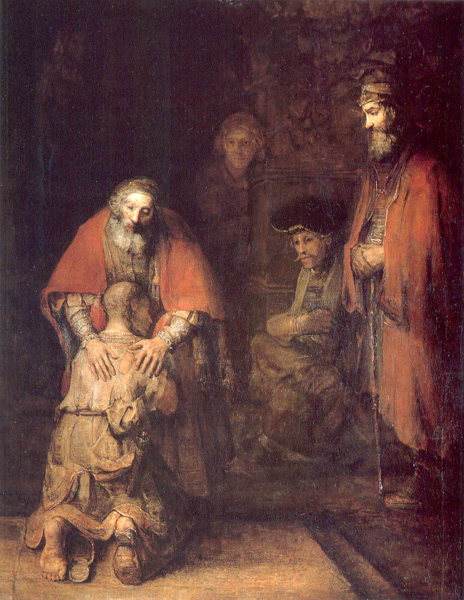
Rembrandt was close to his death when he painted his picture of the Prodigal Son. It was probably one of his last works. It might not be too far fetched to see something of Rembrandt in the old father. A half blind old man, with a moustache and beard laying his large stiff hands on the shoulders of the younger son. What does the nearly blind father see as his hands touch the back of the returning son ?
He sees more than most of us -
An eternal seeing
A seeing that reaches out to all of humanity
He sees and understands how men and women throughout time are lost
He sees and knows the suffering of those who have chosen to leave home
His heart burns with a desire to bring his children home
How much he would have liked to talk to them
warn them against dangers they were facing
To convince them that they will find all they need at home
How much would he have wanted to hold them close
so that they would not get hurt.
But his love cannot force or push or pull.
It offers the freedom to reject that love or to love in return.
Part of that freedom is the chance to leave home,
to go to a distant country
to lose everything.
As father he has to allow this to happen
To let his children pierce his heart
From the place where love embraces grief, the Father reaches out to his children.
The touch of his hands seeks to heal.
The father's hands are at the centre of the painting.
Look at how the light is drawn to them
How each of the people standing and sitting
gaze on the father hands
It is in the hands that we have a visible sign of forgiveness, reconciliation, healing.
In many ways this is a self portrait of Rembrandt
Rembrandt the father who saw his wife, three sons, two daughters, and his two partners die. Rembrandt, like each of us, was created in the image of God.
He discovered through his long painful struggle, the true nature of that image
The image of an almost blind old man, crying, blessing his deeply wounded son.
Then there is the elder son – standing to the right in the picture.
He watches, withdrawn. He looks at the father, but not with joy. He just stands – stiff and erect, a long staff reaching from his hand to the floor.
The fathers hands are spread out, the son’s are clasped together, held close to his chest. The light on the Father engulfs the younger son. The light on the face of the elder son is cold, constricted. His figure is in the dark, his clasped hands in the shadows.
He is truly lost. He has become a foreigner in his own house. Every relationship is in darkness. He can be afraid or show disdain, he can submit or enforce control, he can oppress or be a victim. There is little choice for one outside the light.
Sins cannot be confessed. Forgiveness cannot be recieved, mutual love cannot exist, true communion is impossible.
Is there a way out ?
He needs light, but a light that can conquer darkness
and he cannot bring that about himself
He cannot forgive himself
He cannot make himself feel loved
He cannot bring himself home
He cannot create communion on his own
He cannot make true freedom for himself
That must be given to him
He is lost
To be found he needs to be brought home by the shepherd who goes out to him.
Then there is the younger son
we see him here returning
Coming back
But what about the leaving?
Leaving home in the society that Luke wrote about
meant abandoning community,
values,
tradition.
It was a radical tearing away and rejection of home.
it was a denial of God
Ignoring the truth that God has moulded me,
knitted me together
Leaving home is living as though I do not yet have a home
and must look far and wide to find one.
What are we searching for when we leave home?
A place to belong
A place where we fit
A place where we can find unconditional love.
Let’s focus again on those hands
Hands that have always been stretched out
Hands that give us the freedom to leave home
Yet, hands that are always outstretched to receive us back and words that are whispered
'You are my Beloved, on you my favour rests'.
A portrait
A portrait of Rembrandt
A portrait of each one of us
A portrait of humanity
A portrait of the love of God
What do we see as we gaze at the portrait ?
Sunday 1 June 2008 Healing and Wholeness: 2 Kings 5:1-19a, Luke 17:11-19, Bruce
The point about leprosy is that in bible times it was a death sentence. The prospect of catching it was so awful that the merest suggestion struck fear and loathing into all. If you had any kind of skin blemish or discolouration, it was probable that you would be cast out of society. Naturally, if it was a relatively minor skin infection, it might clear up of itself, and you would be held to be cleansed; hence the prescribed ceremonies at the temple, so that in Judaism, you could be pronounced clean. But if that did not happen, you were an outcast.
The case of Naaman is different. Either because the Syrians were more humane, but probably because he was a highly effective military commander, Naaman still had a place in society. Perhaps he was allowed to go out if he wore a veil, or kept his distance.
He seems to have been a man who inspired loyalty and affection in his servants and subordinates, and to have been valued by the king. Imagine Russell Crowe in full gleaming armour.
The author of Kings tells his story with irony and wit. This supremely powerful commander is helplessly in the control of his dreaded condition. Salvation comes to him through the love of a little servant girl, a captive from Israel – perhaps Naaman himself had commanded the raiding party that had captured her. The girl speaks to her mistress, Naaman’s wife; she speaks to her husband; he speaks to the king; the king sends Naaman off with gifts and a letter to the king if Israel, who panics. It is so obviously impossible for the king to cleanse Naaman of leprosy, that it must be an excuse to invade Israel!
Elisha the prophet hears of this and sends for Naaman. Comically, we can imagine Naaman fuming in the heat outside as messengers emerge from the coolness of Elisha’s house. And then his rug chewing rage at being commanded to go and dip in the muddy Jordan. But we also see touching devotion from his servants as they cajole the great man to go along with the prophet’s command.
So, no doubt with great misgivings and embarrassment, the great general dips himself into the river, and is cleansed!
We have approached this series of sermons about healing and wholeness with some trepidation. Perhaps all of us have had the experience of praying for someone to be healed or helped, but not seeing any obvious answer. We might also have been spoken to by people who have urged us to pray with faith, almost to demand from God that he answers our prayers; where is the place for allowing God to be sovereign if we can seem to take control? So, we seem to have two opposite feelings about prayer in general, and healing in particular, first that it might not “work”, whatever that means, or second that we might be presumptuous in expecting God to do what we want.
I find it helpful to note here that it is God who takes the initiative. It might have been an accident that the servant girl was there, with her brave testimony about the power of the God of her fathers, but I am happy to give him praise for that. Naaman is led to his healing and guided through it. All he has to do is obey and fall in with God’s will.
And then note the true impact on Naaman. He is changed in his heart as well as in his skin. From now on he is relationship with the God of Israel, and him only will he worship; he will stand on the soil of Israel and offer up praises. It might seem superstitious to us, but Elisha recognised this as true faith.
Here was a true wholeness, the peace of God entering a person’s soul. Kim spoke last week of the difference between healing and cure, of how God can bring his shalom into our lives even when the outward situation is still very difficult. Jesus mentions Naaman as an example of God’s grace, but comments that there were many other lepers around at that time who were not healed.(Luke 4:27); his hearers on that occasion were outraged and threatened violence against him.
So Naaman is made whole, truly whole. We wonder if that wholeness is in his new relationship with YHWH God, rather than the physical healing, but we know that the one seems to have led to the other.
If we return to Luke’s gospel, we see a similar dynamic at work. Jesus meets ten lepers, and commands them to go and show themselves to the priests. All ten are obedient and set off, even though as far as we know, they are still lepers. As they travelled, I wonder what sort of conversations they had had, and did they include the Samaritan?
As they travelled, they became aware that the leprosy had left them! Nine of them hastened to obey Jesus’ command and find the priest; after doing that, if given a clean bill of health, they would be able to go back to their families and homes.
One of them, however, does not obey Jesus completely. He turns around and goes back to thank him. So great is his gratitude that he throws himself in the dust at Jesus’ feet.
This poses a question for me. Jesus commends the returning cleansed Samaritan and says his faith has made him well, i.e. the obedience and the return to give thanks. What does this tell us about the other nine? Nothing at all. Perhaps they also offered fervent and heartfelt thanks and praise at the temple. Perhaps they remembered later and sought Jesus out to thank him. In parish ministry, we touch the lives of many people, and hopefully are a help and blessing to them. Only a few come back to us and make it obvious that they are giving praise to God. Our response is to give thanks that they have been helped.
But we can be the one who returned. We can come to God in all our need and receive whatever he offers us. We can seek to follow him even if the way seems strange or hard (why go to the priest to say you are cleansed, while you are still a leper?). We can give him thanks whatever he sends us. We do not make demands of God, but our faces are turned towards him, and we constantly say Kyrie eleison: Lord, have mercy. Who know what he will do?
The case of Naaman is different. Either because the Syrians were more humane, but probably because he was a highly effective military commander, Naaman still had a place in society. Perhaps he was allowed to go out if he wore a veil, or kept his distance.
He seems to have been a man who inspired loyalty and affection in his servants and subordinates, and to have been valued by the king. Imagine Russell Crowe in full gleaming armour.
The author of Kings tells his story with irony and wit. This supremely powerful commander is helplessly in the control of his dreaded condition. Salvation comes to him through the love of a little servant girl, a captive from Israel – perhaps Naaman himself had commanded the raiding party that had captured her. The girl speaks to her mistress, Naaman’s wife; she speaks to her husband; he speaks to the king; the king sends Naaman off with gifts and a letter to the king if Israel, who panics. It is so obviously impossible for the king to cleanse Naaman of leprosy, that it must be an excuse to invade Israel!
Elisha the prophet hears of this and sends for Naaman. Comically, we can imagine Naaman fuming in the heat outside as messengers emerge from the coolness of Elisha’s house. And then his rug chewing rage at being commanded to go and dip in the muddy Jordan. But we also see touching devotion from his servants as they cajole the great man to go along with the prophet’s command.
So, no doubt with great misgivings and embarrassment, the great general dips himself into the river, and is cleansed!
We have approached this series of sermons about healing and wholeness with some trepidation. Perhaps all of us have had the experience of praying for someone to be healed or helped, but not seeing any obvious answer. We might also have been spoken to by people who have urged us to pray with faith, almost to demand from God that he answers our prayers; where is the place for allowing God to be sovereign if we can seem to take control? So, we seem to have two opposite feelings about prayer in general, and healing in particular, first that it might not “work”, whatever that means, or second that we might be presumptuous in expecting God to do what we want.
I find it helpful to note here that it is God who takes the initiative. It might have been an accident that the servant girl was there, with her brave testimony about the power of the God of her fathers, but I am happy to give him praise for that. Naaman is led to his healing and guided through it. All he has to do is obey and fall in with God’s will.
And then note the true impact on Naaman. He is changed in his heart as well as in his skin. From now on he is relationship with the God of Israel, and him only will he worship; he will stand on the soil of Israel and offer up praises. It might seem superstitious to us, but Elisha recognised this as true faith.
Here was a true wholeness, the peace of God entering a person’s soul. Kim spoke last week of the difference between healing and cure, of how God can bring his shalom into our lives even when the outward situation is still very difficult. Jesus mentions Naaman as an example of God’s grace, but comments that there were many other lepers around at that time who were not healed.(Luke 4:27); his hearers on that occasion were outraged and threatened violence against him.
So Naaman is made whole, truly whole. We wonder if that wholeness is in his new relationship with YHWH God, rather than the physical healing, but we know that the one seems to have led to the other.
If we return to Luke’s gospel, we see a similar dynamic at work. Jesus meets ten lepers, and commands them to go and show themselves to the priests. All ten are obedient and set off, even though as far as we know, they are still lepers. As they travelled, I wonder what sort of conversations they had had, and did they include the Samaritan?
As they travelled, they became aware that the leprosy had left them! Nine of them hastened to obey Jesus’ command and find the priest; after doing that, if given a clean bill of health, they would be able to go back to their families and homes.
One of them, however, does not obey Jesus completely. He turns around and goes back to thank him. So great is his gratitude that he throws himself in the dust at Jesus’ feet.
This poses a question for me. Jesus commends the returning cleansed Samaritan and says his faith has made him well, i.e. the obedience and the return to give thanks. What does this tell us about the other nine? Nothing at all. Perhaps they also offered fervent and heartfelt thanks and praise at the temple. Perhaps they remembered later and sought Jesus out to thank him. In parish ministry, we touch the lives of many people, and hopefully are a help and blessing to them. Only a few come back to us and make it obvious that they are giving praise to God. Our response is to give thanks that they have been helped.
But we can be the one who returned. We can come to God in all our need and receive whatever he offers us. We can seek to follow him even if the way seems strange or hard (why go to the priest to say you are cleansed, while you are still a leper?). We can give him thanks whatever he sends us. We do not make demands of God, but our faces are turned towards him, and we constantly say Kyrie eleison: Lord, have mercy. Who know what he will do?
Saturday, 31 May 2008
Sunday 25 May 2008 Healing Kim
Healing
‘I came that they may have life, and have it abundantly’ (John 10:10)
We all long for that, but how do we achieve it? Some people put their trust in something like the lottery – fullness of life, they say, will be possible when we can pay off our debts and buy all we want. But those who pray for healing acknowledge that there are deeper needs than those for which money can provide. Good though it might be to be out of debt, able to do what we want without having to go without something else, deep down we know that we have other needs.
The ministry of prayer for healing and wholeness is a way of addressing those needs which the Church has encouraged right from the early days. James 5:13-16 indicates that this ministry was a part of church practice from an early stage. It sprang out of a realisation that healing lay at the heart of Jesus’ ministry, as he healed physical and emotional pain, eased strained relationships with forgiveness, and encouraged people to realise that God’s love is stronger than whatever may be disturbing us.
But what is healing? It is probably helpful to recognise that it is not necessarily the same as a cure. In some Christian traditions, you would expect to find a heap of crutches or hearing aids left behind after a service of prayer for healing, because they were no longer necessary. That may happen, but if it doesn’t, it will not mean that healing has not taken place.
I learnt most about the difference between healing and cure when my sister was diagnosed with cancer for the second time. At first I prayed very hard that she would get better. But her cancer was too far advanced for that, and however hard I prayed, it soon became obvious that she was going to die – and the longer she lived, the more she would suffer. Gradually my prayer changed, as I began to realise that for her, healing would only come through death. And perhaps that is always the truth, that only death will give us the freedom to be truly whole. It was not easy to accept. I often felt very angry. And part of my healing was to realise that it is all right to be angry with God. God is big enough to take it – that’s part of what the cross is about.
God was at work then, changing my sister, changing me, changing the family, leading us all on to something new. Although there was no cure (my sister died), I’m sure there was healing. It showed in my sister’s courage in facing pain and death; it showed in the way we as a family were drawn closer together and began to be able to express our love for each other more openly; it showed in the way we were set free from fear and anxiety. That doesn’t mean that her death didn’t hurt – it was a painful letting go all round. But it led on to something new. Healing does not mean going back to what one was before, it is a growing on to a new stage. It can be painful and costly as the growth takes us through many deaths and resurrections on our way to life.
Healing may take us by surprise – after one healing service I attended, a woman who was going blind said, ‘I know I’m going blind, but after tonight, I’m not afraid.’ Prayer for healing means opening ourselves up to God’s love, asking God to give us what God knows we need, rather than putting a lot of energy into asking for what we want. We might do well to remember those four men who brought their paralysed friend to Jesus, with energy that let nothing stand in their way (Mark 2:1-12). No doubt they wanted their friend to walk again but, wisely, they did not restrict Jesus’ actions by saying so. They let Jesus deal with what lay at the root of the man’s illness, and Jesus set him free from whatever it was that had left him helpless, literally without a leg to stand on for so long.
So, we come asking for healing, perhaps knowing our need, perhaps with a sense of need we can not put into words. Or we might come because, like those four men, we want to bring someone else to Jesus for his healing touch. We might come in gratitude that we are being healed, with a longing that our spiritual life will be strengthened and deepened.
The result of our prayer will be an expression of God’s love for us. It may be the disappearance of whatever is troubling us, it may be a new appreciation of our own worth; it may be a new determination to work for social changes that will bring wholeness to others; it may be fresh courage to face an old situation. We may not be aware that anything has happened until later. But God will respond with his healing gifts at whatever level we can receive them. And then we can go out to offer his healing to those around us, for healing is not just for individuals. ‘I can not be whole while my brothers and sisters in the world are in need’. Part of the healing we must pray for is that society, ours and others’, and our church communities too, will change so that all people will be free to find their wholeness. Part of our wholeness will come as we work for the peace, freedom and justice, which are God’s will for us all.
Does God heal today? I believe he does. What about you? Another question – ‘Do you want to be healed?’ That I might sound like a silly question but think about it. Prayer for healing whatever it might be; will bring a change – in the situation, individual, community. A change for the better and for some people that might be too much to cope with – maybe the prayer here should be for courage to be changed.
There are times when God’s healing gets hampered because we haven’t done something – like Norma, a friend of mine who had a knee problem. On one visit I asked her if she prayed for herself. Norma said that Don her husband and Mark her son had, and that was sufficient. ‘There are plenty of others in much greater need than I and of course I pray for them’. ‘Do you not think that you are just as important to God as all the others you pray for?’ I asked. ‘Yes’ she replied. Then ‘pray for yourself;’ I said. She did, and the next day she got up and the pain had gone and she was walking around as if nothing had happen. We can sometimes get caught up in the busyness of praying for others or we feel that others are more important that we forget or don’t feel we should ask God for ourselves. We are just as loved and important to him as the next person.
In the Gospel reading, the four friends dug through the roof of Jesus’ house to get their friend to see Jesus so it is quite possible for us to understand why Jesus said what he said to the paralysed man. How would you feel if someone made a big hole in your roof? But Jesus looks down and with a smile; says ‘All right – I forgive you!’ Of course Jesus was referring to something wrong in this man’s life – something deep rooted – something only Jesus knew. Sin can sometimes stand in the way of God doing his very best for us. It is good that we can confess our sins before God. It is also necessary for us to forgive ourselves, and I often find that difficult to do. Sometimes we find ourselves a victim of circumstance and are hurt, we know we should forgive but we can’t – maybe that’s the time to ask God to bring you to a time when you are able to forgive. You may need help with this – ask a trusted friend or a member of the pastoral team or clergy. Un-forgiveness, stress, over work can lead to physical, mental and emotional problems – even death.
A prayer for healing can be for anything. Often people think healing and forgiveness is impossible. They find God distant or uncaring or feel they are not worth God bothering with. The Gospel story is a picture of prayer. Don’t stay on the edge of the crowd. Dig through God’s roof and find yourself in his presence. You will get more than you are bargained for. It’s not pleasant if you’re helpless on a stretcher, but you do not have many responsibilities. BUT once you have met the living, forgiving, loving God in Jesus, you will find yourself on your feet, going out into the world in the power of God’s love.
Questions:
1. What are your feelings about praying for healing?
2. Have you ever had prayer for healing before? If you are able, could you explain what happened?
3. What concerns, feelings, if any, do you have in asking for prayer for healing?
4. Would you, possibly with a church friend, go to pray with a sick person?
‘I came that they may have life, and have it abundantly’ (John 10:10)
We all long for that, but how do we achieve it? Some people put their trust in something like the lottery – fullness of life, they say, will be possible when we can pay off our debts and buy all we want. But those who pray for healing acknowledge that there are deeper needs than those for which money can provide. Good though it might be to be out of debt, able to do what we want without having to go without something else, deep down we know that we have other needs.
The ministry of prayer for healing and wholeness is a way of addressing those needs which the Church has encouraged right from the early days. James 5:13-16 indicates that this ministry was a part of church practice from an early stage. It sprang out of a realisation that healing lay at the heart of Jesus’ ministry, as he healed physical and emotional pain, eased strained relationships with forgiveness, and encouraged people to realise that God’s love is stronger than whatever may be disturbing us.
But what is healing? It is probably helpful to recognise that it is not necessarily the same as a cure. In some Christian traditions, you would expect to find a heap of crutches or hearing aids left behind after a service of prayer for healing, because they were no longer necessary. That may happen, but if it doesn’t, it will not mean that healing has not taken place.
I learnt most about the difference between healing and cure when my sister was diagnosed with cancer for the second time. At first I prayed very hard that she would get better. But her cancer was too far advanced for that, and however hard I prayed, it soon became obvious that she was going to die – and the longer she lived, the more she would suffer. Gradually my prayer changed, as I began to realise that for her, healing would only come through death. And perhaps that is always the truth, that only death will give us the freedom to be truly whole. It was not easy to accept. I often felt very angry. And part of my healing was to realise that it is all right to be angry with God. God is big enough to take it – that’s part of what the cross is about.
God was at work then, changing my sister, changing me, changing the family, leading us all on to something new. Although there was no cure (my sister died), I’m sure there was healing. It showed in my sister’s courage in facing pain and death; it showed in the way we as a family were drawn closer together and began to be able to express our love for each other more openly; it showed in the way we were set free from fear and anxiety. That doesn’t mean that her death didn’t hurt – it was a painful letting go all round. But it led on to something new. Healing does not mean going back to what one was before, it is a growing on to a new stage. It can be painful and costly as the growth takes us through many deaths and resurrections on our way to life.
Healing may take us by surprise – after one healing service I attended, a woman who was going blind said, ‘I know I’m going blind, but after tonight, I’m not afraid.’ Prayer for healing means opening ourselves up to God’s love, asking God to give us what God knows we need, rather than putting a lot of energy into asking for what we want. We might do well to remember those four men who brought their paralysed friend to Jesus, with energy that let nothing stand in their way (Mark 2:1-12). No doubt they wanted their friend to walk again but, wisely, they did not restrict Jesus’ actions by saying so. They let Jesus deal with what lay at the root of the man’s illness, and Jesus set him free from whatever it was that had left him helpless, literally without a leg to stand on for so long.
So, we come asking for healing, perhaps knowing our need, perhaps with a sense of need we can not put into words. Or we might come because, like those four men, we want to bring someone else to Jesus for his healing touch. We might come in gratitude that we are being healed, with a longing that our spiritual life will be strengthened and deepened.
The result of our prayer will be an expression of God’s love for us. It may be the disappearance of whatever is troubling us, it may be a new appreciation of our own worth; it may be a new determination to work for social changes that will bring wholeness to others; it may be fresh courage to face an old situation. We may not be aware that anything has happened until later. But God will respond with his healing gifts at whatever level we can receive them. And then we can go out to offer his healing to those around us, for healing is not just for individuals. ‘I can not be whole while my brothers and sisters in the world are in need’. Part of the healing we must pray for is that society, ours and others’, and our church communities too, will change so that all people will be free to find their wholeness. Part of our wholeness will come as we work for the peace, freedom and justice, which are God’s will for us all.
Does God heal today? I believe he does. What about you? Another question – ‘Do you want to be healed?’ That I might sound like a silly question but think about it. Prayer for healing whatever it might be; will bring a change – in the situation, individual, community. A change for the better and for some people that might be too much to cope with – maybe the prayer here should be for courage to be changed.
There are times when God’s healing gets hampered because we haven’t done something – like Norma, a friend of mine who had a knee problem. On one visit I asked her if she prayed for herself. Norma said that Don her husband and Mark her son had, and that was sufficient. ‘There are plenty of others in much greater need than I and of course I pray for them’. ‘Do you not think that you are just as important to God as all the others you pray for?’ I asked. ‘Yes’ she replied. Then ‘pray for yourself;’ I said. She did, and the next day she got up and the pain had gone and she was walking around as if nothing had happen. We can sometimes get caught up in the busyness of praying for others or we feel that others are more important that we forget or don’t feel we should ask God for ourselves. We are just as loved and important to him as the next person.
In the Gospel reading, the four friends dug through the roof of Jesus’ house to get their friend to see Jesus so it is quite possible for us to understand why Jesus said what he said to the paralysed man. How would you feel if someone made a big hole in your roof? But Jesus looks down and with a smile; says ‘All right – I forgive you!’ Of course Jesus was referring to something wrong in this man’s life – something deep rooted – something only Jesus knew. Sin can sometimes stand in the way of God doing his very best for us. It is good that we can confess our sins before God. It is also necessary for us to forgive ourselves, and I often find that difficult to do. Sometimes we find ourselves a victim of circumstance and are hurt, we know we should forgive but we can’t – maybe that’s the time to ask God to bring you to a time when you are able to forgive. You may need help with this – ask a trusted friend or a member of the pastoral team or clergy. Un-forgiveness, stress, over work can lead to physical, mental and emotional problems – even death.
A prayer for healing can be for anything. Often people think healing and forgiveness is impossible. They find God distant or uncaring or feel they are not worth God bothering with. The Gospel story is a picture of prayer. Don’t stay on the edge of the crowd. Dig through God’s roof and find yourself in his presence. You will get more than you are bargained for. It’s not pleasant if you’re helpless on a stretcher, but you do not have many responsibilities. BUT once you have met the living, forgiving, loving God in Jesus, you will find yourself on your feet, going out into the world in the power of God’s love.
Questions:
1. What are your feelings about praying for healing?
2. Have you ever had prayer for healing before? If you are able, could you explain what happened?
3. What concerns, feelings, if any, do you have in asking for prayer for healing?
4. Would you, possibly with a church friend, go to pray with a sick person?
TRINITY SUNDAY 18 May 2008 Matthew 28:16-20 Bruce
Here we have a sense of fullness and completion. Themes from all through the gospel are brought together.
Then the eleven disciples went to Galilee, to the mountain where Jesus had told them to go.
When they saw him, they worshipped him; but some doubted.
All through the gospel, the question has been “Who is Jesus, and should we trust him?” The disciples gather in obedience and offer him worship, but even at this time we are told that some doubted. It is the sort of detail that I would have left out.
Then Jesus came to them and said, "All authority in heaven and on earth has been given to me.
Therefore go and make disciples of all nations,
baptizing them in the name of the Father and of the Son and of the Holy Spirit,
and teaching them to obey everything I have commanded you.
And surely I am with you always, to the very end of the age."
We have here five thoughts or statements, and four alls.
All authority
All nations
All things
All the days
Jesus says that he has been given “All authority”. This answers a question from the beginning of the gospel. Since the birth of an infant king was announced and Herod tried to use the magi to locate this potential rival, the questions have been who is this Jesus, and how will he bring in the kingly rule of YHWH God? The questions have now been answered by the resurrection of Jesus, and now he has been given all authority.
He commands that his followers go and “disciple” all nations, or peoples. No-one is to be excluded. The way that Jesus’ authority will be made concrete will be as people are encouraged to submit themselves as disciples to Jesus. Matthew is having a little joke here: to disciple is to mattheteusate, to become like Matthew who is a dedicated learner and disciple of his Lord. And to be a dedicated disciple is to be involved in sharing, reaching out, to any and every other person around us.
Part of “discipling” is to teach, to model how it is done, that we observe all of Jesus’ commandments – “all things” that he has commanded us. This lays on us a duty and a desire to make ourselves familiar with all he has commanded us – to read and study his word. And to engage with all of it, even the bits we find difficult or unpalatable. There are difficulties here. Infants can be massacred, the innocent suffer – including the guiltless Son of God, millions can perish or be made homeless by flood and earthquake. And yet Jesus has all authority,, and God is love. In terms of the high moral standard that Jesus lays down for us, we are not free to pick and mix those parts that we find easy or conducive to a happy life.
And Jesus says that he is with us “all the days”, translated always. On good days and bad days, on exam days and results days, on work days and beach days, on washing days and rest days, on good health days and sickness days, on wedding days and baptism days, on funeral days and resurrection days, he is always with us and we are always with him. Unlike unhappy Gretna Football Club, where millionaire owner Brooks Mileson poured in large amounts of money and took them from obscurity to the Scottish Premier league; when Mr Mileson was laid low by sickness, the money stopped and consequently the club is about to go into administration. We can rely upon Jesus all of our days.
We are dealing in superlatives. There is a richness, a fullness in all the Jesus has done and is doing, and in who he is. And this is born out in the command from this passage that does not contain the word all.
We are to baptise in the name of the Father, of the Son and of the Holy Spirit. Here we find a completeness that is beyond our easy understanding but which is satisfying and brings us joy.
Jesus is given all authority precisely because he does not crave power; he is content to submit himself to his Father’s will.
There is a mutual love and self giving that flows between the three, that overflows and reaches out to all peoples, and we are caught up in that.
Jesus is happy to do all the Father asks; so are we and we are also happy to share this with all those around us.
And finally, Jesus is no longer with us here on earth, but he is present with us and in us, by the Holy Spirit of God.
We are to ‘disciple’ all nations, and to baptise them either ‘in’ or ‘into’ the name of the Holy Three. May we know the grace of God, not merely to think about him, to talk about him or to sing about him, but to encounter him, to experience his love, Father, Son and Holy Spirit.
Then the eleven disciples went to Galilee, to the mountain where Jesus had told them to go.
When they saw him, they worshipped him; but some doubted.
All through the gospel, the question has been “Who is Jesus, and should we trust him?” The disciples gather in obedience and offer him worship, but even at this time we are told that some doubted. It is the sort of detail that I would have left out.
Then Jesus came to them and said, "All authority in heaven and on earth has been given to me.
Therefore go and make disciples of all nations,
baptizing them in the name of the Father and of the Son and of the Holy Spirit,
and teaching them to obey everything I have commanded you.
And surely I am with you always, to the very end of the age."
We have here five thoughts or statements, and four alls.
All authority
All nations
All things
All the days
Jesus says that he has been given “All authority”. This answers a question from the beginning of the gospel. Since the birth of an infant king was announced and Herod tried to use the magi to locate this potential rival, the questions have been who is this Jesus, and how will he bring in the kingly rule of YHWH God? The questions have now been answered by the resurrection of Jesus, and now he has been given all authority.
He commands that his followers go and “disciple” all nations, or peoples. No-one is to be excluded. The way that Jesus’ authority will be made concrete will be as people are encouraged to submit themselves as disciples to Jesus. Matthew is having a little joke here: to disciple is to mattheteusate, to become like Matthew who is a dedicated learner and disciple of his Lord. And to be a dedicated disciple is to be involved in sharing, reaching out, to any and every other person around us.
Part of “discipling” is to teach, to model how it is done, that we observe all of Jesus’ commandments – “all things” that he has commanded us. This lays on us a duty and a desire to make ourselves familiar with all he has commanded us – to read and study his word. And to engage with all of it, even the bits we find difficult or unpalatable. There are difficulties here. Infants can be massacred, the innocent suffer – including the guiltless Son of God, millions can perish or be made homeless by flood and earthquake. And yet Jesus has all authority,, and God is love. In terms of the high moral standard that Jesus lays down for us, we are not free to pick and mix those parts that we find easy or conducive to a happy life.
And Jesus says that he is with us “all the days”, translated always. On good days and bad days, on exam days and results days, on work days and beach days, on washing days and rest days, on good health days and sickness days, on wedding days and baptism days, on funeral days and resurrection days, he is always with us and we are always with him. Unlike unhappy Gretna Football Club, where millionaire owner Brooks Mileson poured in large amounts of money and took them from obscurity to the Scottish Premier league; when Mr Mileson was laid low by sickness, the money stopped and consequently the club is about to go into administration. We can rely upon Jesus all of our days.
We are dealing in superlatives. There is a richness, a fullness in all the Jesus has done and is doing, and in who he is. And this is born out in the command from this passage that does not contain the word all.
We are to baptise in the name of the Father, of the Son and of the Holy Spirit. Here we find a completeness that is beyond our easy understanding but which is satisfying and brings us joy.
Jesus is given all authority precisely because he does not crave power; he is content to submit himself to his Father’s will.
There is a mutual love and self giving that flows between the three, that overflows and reaches out to all peoples, and we are caught up in that.
Jesus is happy to do all the Father asks; so are we and we are also happy to share this with all those around us.
And finally, Jesus is no longer with us here on earth, but he is present with us and in us, by the Holy Spirit of God.
We are to ‘disciple’ all nations, and to baptise them either ‘in’ or ‘into’ the name of the Holy Three. May we know the grace of God, not merely to think about him, to talk about him or to sing about him, but to encounter him, to experience his love, Father, Son and Holy Spirit.
Sunday 11 May 2008 Pentecost Acts 2:1-21 John 7:37-39 Bruce
Introduction
It is a lovely time of the year in the garden. You can hear the breeze gently ruffling the tops of trees and listen to the birds sing. You can smell the smoke of a wood fire. At other times the wind can blow in a furious storm, or you can get caught in a sudden heavy shower that instantly drenches you to the skin. All these are images used in the bible to try to describe the indescribable.
Today we celebrate the Feast of Pentecost, what many would call the birthday of the Church. In the Gospels, as well as foretelling his death and resurrection, Jesus goes into some detail about the coming of the Holy Spirit of God to his disciples. And so after the wonder that the disciples must have felt at the Ascension, which Melanie talked about last week, we come to an even more surprising event this week, the coming of the Spirit. When we read in Exodus that God delivered Israel from Egypt, bringing them through the Red Sea, it took them 50 days to reach Sinai, where God gave them the Torah, the Law. God went with them, guiding them by a pillar of cloud during the day and a pillar of fire by night. God dwelt in the midst of the camp, in a specially constructed tent structure that served the same function as the temple was later to do.
A New Presence
God is present throughout his world. We are not pantheists, who believe that every rock, every animal, every blade of grass is divine. But by the same token we are not deists, believing that God created this world, set it running, and is now watching from a distance, in no way connected with us. Rather, we live in a world where heaven and earth are connected, overlaid the one on the other. The many angels you can see portrayed in stone and stained glass around this beautiful building are meant to symbolise to us the presence of the divine around and within us. We read often in what we call the Old Testament, of the Spirit of God resting on someone to bring special powers or equip them for a special task.
Jesus promised that in the new dispensation, each and every Christian would have the Holy Spirit welling up from within. This promise was kept on the day of Pentecost, in a way that was obvious not just to everyone present, but to the crowds in the streets outside.
Many of us struggle with feelings of inadequacy, feeling that we are not equipped to lead the Christian life. We struggle because it is true! To be a Christian, it is not enough to study the bible, to know what Christians believe, or struggle to live worthy moral lives in the way that Christians should, or to attend worship with other Christian folk.
How do you give yourself a sun tan? Only by exposing yourself to the sun’s rays and soaking them up. Can you stop your thirst by deciding that you are no longer thirsty? How much better to accept the refreshing drink that is being offered to you?
How can you encounter God and grow in him? By trusting in his Son Jesus, and opening yourself to the presence of his Spirit.
A New Unity
Jesus said that others would know that we are Christians by the love we have for each other, by our unity in him. The synagogue reading for Pentecost is the account of the dividing of the peoples at Babel – the coming of a fundamental disunity into the world. One of the chief effects of the coming of the Spirit was a new spirit of unity and cooperation between the Christians in the early church. “When the day of Pentecost came, they were all together in one place.” “Then Peter stood up with the eleven ..” Just as Father, Son and Spirit live as one, and yet are distinct, interconnected lovers whose love permeates the whole of creation, so we are made one with the Father and the Son by the work of the Spirit, and we are made one with each other. We may not always instantly agree on every detail, we may even fall out occasionally, but we are essentially one. We are united at a level that cannot be defined or denied, if the Spirit lives in us.
A New Inclusivity
The coming of the Holy Spirit at Pentecost makes it abundantly clear that God’s love is not reserved for a favoured few, whether from a special nation or of a special cast. The list of nations that Margaret read for us summarises the whole known world for a first century Roman citizen. The point is that everyone was connected; they each heard the good news about Jesus in their own native language. Peter quotes the prophet Joel to show that in Old Testament times God was pointing forward to a time when he would pour out his Spirit “on all people”; “everyone who calls on the name of the Lord will be saved”.
This means that what is described in the book of Acts is for everyone here this morning. There are no exceptions.
Of course, there are plenty of other references to people’s encounters with the Holy Spirit than the one we have read this morning, and every other New Testament book has wonderful, encouraging things to teach us about his work within us. The evidence is that God worked in different ways for different people, always seeking to bless each one and draw them to himself.
So who is the Holy Spirit NOT for? I would say only for those who are not prepared or willing to open themselves to his kind, gracious presence. Some might say also those with whom we have not yet shared the good news about Jesus, but I believe that God reaches out by his Spirit to people any and every where, to all those who are open and searching for him. One evidence of the work of the Spirit in us might be a growing desire and confidence to share the love of God with those we come into contact with.
Suggested Questions
1. What do we think about the work of the Holy Spirit within us?
2. What do we feel about the work of the Holy Spirit within us?
3. What are our aspirations for St Michael’s, as a community of the Holy Spirit?
It is a lovely time of the year in the garden. You can hear the breeze gently ruffling the tops of trees and listen to the birds sing. You can smell the smoke of a wood fire. At other times the wind can blow in a furious storm, or you can get caught in a sudden heavy shower that instantly drenches you to the skin. All these are images used in the bible to try to describe the indescribable.
Today we celebrate the Feast of Pentecost, what many would call the birthday of the Church. In the Gospels, as well as foretelling his death and resurrection, Jesus goes into some detail about the coming of the Holy Spirit of God to his disciples. And so after the wonder that the disciples must have felt at the Ascension, which Melanie talked about last week, we come to an even more surprising event this week, the coming of the Spirit. When we read in Exodus that God delivered Israel from Egypt, bringing them through the Red Sea, it took them 50 days to reach Sinai, where God gave them the Torah, the Law. God went with them, guiding them by a pillar of cloud during the day and a pillar of fire by night. God dwelt in the midst of the camp, in a specially constructed tent structure that served the same function as the temple was later to do.
A New Presence
God is present throughout his world. We are not pantheists, who believe that every rock, every animal, every blade of grass is divine. But by the same token we are not deists, believing that God created this world, set it running, and is now watching from a distance, in no way connected with us. Rather, we live in a world where heaven and earth are connected, overlaid the one on the other. The many angels you can see portrayed in stone and stained glass around this beautiful building are meant to symbolise to us the presence of the divine around and within us. We read often in what we call the Old Testament, of the Spirit of God resting on someone to bring special powers or equip them for a special task.
Jesus promised that in the new dispensation, each and every Christian would have the Holy Spirit welling up from within. This promise was kept on the day of Pentecost, in a way that was obvious not just to everyone present, but to the crowds in the streets outside.
Many of us struggle with feelings of inadequacy, feeling that we are not equipped to lead the Christian life. We struggle because it is true! To be a Christian, it is not enough to study the bible, to know what Christians believe, or struggle to live worthy moral lives in the way that Christians should, or to attend worship with other Christian folk.
How do you give yourself a sun tan? Only by exposing yourself to the sun’s rays and soaking them up. Can you stop your thirst by deciding that you are no longer thirsty? How much better to accept the refreshing drink that is being offered to you?
How can you encounter God and grow in him? By trusting in his Son Jesus, and opening yourself to the presence of his Spirit.
A New Unity
Jesus said that others would know that we are Christians by the love we have for each other, by our unity in him. The synagogue reading for Pentecost is the account of the dividing of the peoples at Babel – the coming of a fundamental disunity into the world. One of the chief effects of the coming of the Spirit was a new spirit of unity and cooperation between the Christians in the early church. “When the day of Pentecost came, they were all together in one place.” “Then Peter stood up with the eleven ..” Just as Father, Son and Spirit live as one, and yet are distinct, interconnected lovers whose love permeates the whole of creation, so we are made one with the Father and the Son by the work of the Spirit, and we are made one with each other. We may not always instantly agree on every detail, we may even fall out occasionally, but we are essentially one. We are united at a level that cannot be defined or denied, if the Spirit lives in us.
A New Inclusivity
The coming of the Holy Spirit at Pentecost makes it abundantly clear that God’s love is not reserved for a favoured few, whether from a special nation or of a special cast. The list of nations that Margaret read for us summarises the whole known world for a first century Roman citizen. The point is that everyone was connected; they each heard the good news about Jesus in their own native language. Peter quotes the prophet Joel to show that in Old Testament times God was pointing forward to a time when he would pour out his Spirit “on all people”; “everyone who calls on the name of the Lord will be saved”.
This means that what is described in the book of Acts is for everyone here this morning. There are no exceptions.
Of course, there are plenty of other references to people’s encounters with the Holy Spirit than the one we have read this morning, and every other New Testament book has wonderful, encouraging things to teach us about his work within us. The evidence is that God worked in different ways for different people, always seeking to bless each one and draw them to himself.
So who is the Holy Spirit NOT for? I would say only for those who are not prepared or willing to open themselves to his kind, gracious presence. Some might say also those with whom we have not yet shared the good news about Jesus, but I believe that God reaches out by his Spirit to people any and every where, to all those who are open and searching for him. One evidence of the work of the Spirit in us might be a growing desire and confidence to share the love of God with those we come into contact with.
Suggested Questions
1. What do we think about the work of the Holy Spirit within us?
2. What do we feel about the work of the Holy Spirit within us?
3. What are our aspirations for St Michael’s, as a community of the Holy Spirit?
Sunday 4 May 2008 Acts 1:6-14 Melanie
We pray that God would meet us where we are and move us on to where he would have us be
Amen
Words can be life affirming
Comforting, enabling
There are words of rejoicing, praising
celebration
we can pronounce words of wisdom
Acclaim words of honour
Sing words of worship
Announce words of freedom
wonder at words of prophecy
Whisper words of healing
But what happens when words stop
When words are not enough
when words seem shabby
when words that once had meaning
lose that meaning
When words that in the past gave expression
to our innermost feelings
now seem meaningless
trapping us in a world of emotions
that cannot be expressed.
It's not a comfortable place.
We are so used to expressing ourselves
Communicating in a verbal or written language
And yet its a place that the disciples came to.
The disciples who were full of talk-Peter with all his bluster. James and John, with their demands for priority in heaven-Thomas-full of arguments, and insisting on scientific evidence.
The disciples who were never lost for words
Now in that place where words seemed inadequate.
As they gazed up to heaven-
what words could describe what they were seeing and feeling.
Suddenly they were confronted with following a God that was no longer with them in human form.
A God who would not respond in the same way to their human words.
A God who was suddenly hidden from sight
Beyond words.; beyond human language
What could they be left with-but silence
It's all that we are left with at times.
Times of awe inspiring wonder-the intake of breath
at a beautiful view
Times of mystery-the held silence at the end of a
music concert
Times of sadness or bereavement-when there are no words but we are held in each others silence
From within that silence we are still called to
listen and respond to a God who is both hidden and visible.
How do we do this.
How do we find God in the spaces between words?
we will all find our own ways, some will find God in the depths of music
others will find God in nature
Others will find God in the creative arts-in sewing, carpentry, painting
Recently I have been praying using a book of pictures.
They aren't profound
Sometimes they are as simple as a chair and an empty room.
Yet something about them helps me to find a window on God without using words
Perhaps what we see in the disciples is that same movement beyond words,
The realisation that what they were experiencing went beyond human Ianguage-that it needed a new language.
A different way of being with God.
We'll see more of how that happened in a few weeks when
we remember the first Pentecost after Jesus’ Ascension.
But we are faced with the same challenge today.
How do we communicate with a God who is both hidden
and present
How do we find God in a language beyond human words
How do we express what at times seems inexpressible
Perhaps like the disciples, the language of silence is all we have to offer.
Amen
Words can be life affirming
Comforting, enabling
There are words of rejoicing, praising
celebration
we can pronounce words of wisdom
Acclaim words of honour
Sing words of worship
Announce words of freedom
wonder at words of prophecy
Whisper words of healing
But what happens when words stop
When words are not enough
when words seem shabby
when words that once had meaning
lose that meaning
When words that in the past gave expression
to our innermost feelings
now seem meaningless
trapping us in a world of emotions
that cannot be expressed.
It's not a comfortable place.
We are so used to expressing ourselves
Communicating in a verbal or written language
And yet its a place that the disciples came to.
The disciples who were full of talk-Peter with all his bluster. James and John, with their demands for priority in heaven-Thomas-full of arguments, and insisting on scientific evidence.
The disciples who were never lost for words
Now in that place where words seemed inadequate.
As they gazed up to heaven-
what words could describe what they were seeing and feeling.
Suddenly they were confronted with following a God that was no longer with them in human form.
A God who would not respond in the same way to their human words.
A God who was suddenly hidden from sight
Beyond words.; beyond human language
What could they be left with-but silence
It's all that we are left with at times.
Times of awe inspiring wonder-the intake of breath
at a beautiful view
Times of mystery-the held silence at the end of a
music concert
Times of sadness or bereavement-when there are no words but we are held in each others silence
From within that silence we are still called to
listen and respond to a God who is both hidden and visible.
How do we do this.
How do we find God in the spaces between words?
we will all find our own ways, some will find God in the depths of music
others will find God in nature
Others will find God in the creative arts-in sewing, carpentry, painting
Recently I have been praying using a book of pictures.
They aren't profound
Sometimes they are as simple as a chair and an empty room.
Yet something about them helps me to find a window on God without using words
Perhaps what we see in the disciples is that same movement beyond words,
The realisation that what they were experiencing went beyond human Ianguage-that it needed a new language.
A different way of being with God.
We'll see more of how that happened in a few weeks when
we remember the first Pentecost after Jesus’ Ascension.
But we are faced with the same challenge today.
How do we communicate with a God who is both hidden
and present
How do we find God in a language beyond human words
How do we express what at times seems inexpressible
Perhaps like the disciples, the language of silence is all we have to offer.
Subscribe to:
Posts (Atom)